Personal memory · Summer 1984
The summer we saved inside the Electron.
Before my sister left for university, we turned an Acorn Electron into a map of our childhood—and made one last adventure we could finish together.
The summer my sister Anna left home was the hottest I remember. The grass behind our house turned the colour of straw, the windows stayed open after midnight, and every room seemed to be waiting for something nobody wanted to mention.
Anna was eighteen and had won a place at university. I was thirteen and considered this a personal betrayal.
For most of my life she had been the person ahead of me: first to cross the road alone, first to ride a bicycle without hands, first to discover which floorboard creaked outside our parents’ bedroom. She taught me card games, corrected my lies and rescued me from a tree when I climbed too high. Now she was filling boxes with books and labelling them in thick black pen.
I answered her departure by becoming unpleasant. I borrowed things without asking. I complained about the music from her room. When she tried to discuss university, I reminded her that the city was famous for rain.
Our parents hoped a shared project might restore peace. Father brought home an Acorn Electron.
The smaller Acorn
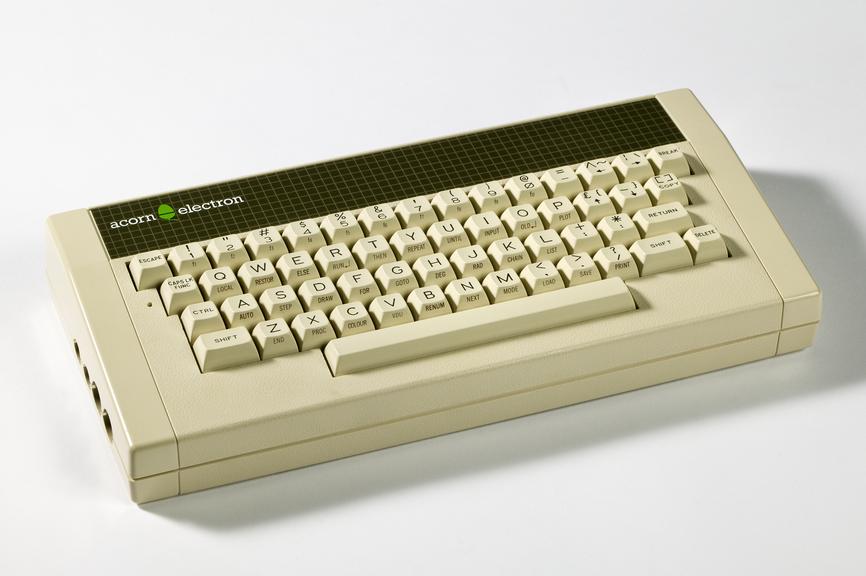
The computer came from a shop that had ordered too many before Christmas. Its price had been reduced, which Father mentioned several times. He placed the cream-and-black machine on the dining table, connected it to the television and announced that it was for both of us.
Anna recognised it from the BBC Micro at school. The Electron was smaller, with fewer connections and a compact keyboard, but it used the same clear version of BASIC. To me, its sloping case and coloured function keys looked wonderfully grown-up.
We began with a cassette of games. Loading took patience. The Electron sometimes seemed to consider each section of tape before accepting it. Anna sat cross-legged on the carpet, reading a novel until the title screen appeared. I watched the cassette counter as if concentration could prevent an error.
One game was a text adventure. The screen described a ruined castle, and we typed instructions: GO NORTH, TAKE KEY, OPEN DOOR. We drew a map on the back of an envelope, argued about directions and died repeatedly in the same underground passage.
“We could make a better one,” Anna said.
“With graphics?”
“With us in it.”
She opened the manual to the chapter on strings and arrays. For the first time that summer, her boxes remained untouched all afternoon.
A map of ordinary places
Our adventure began at the gate of our house. From there, the player could go east to the corner shop, north to the railway bridge or west towards the playing field. Each place came from our childhood, although we renamed it just enough to make it magical.
The drainage tunnel beneath the road became the Cavern of Echoes. Mrs Harris’s overgrown garden became the Forest of Thorns. The abandoned signal hut beside the railway became the Watchtower, guarded by a creature suspiciously similar to the stationmaster who had once caught us placing coins on the track.
Anna wrote descriptions. I designed puzzles. To cross the Cavern, the player needed the torch hidden in our father’s shed. To obtain it, they first had to give the corner-shop owner a lost cat. The cat could be tempted from the Forest with a tin of sardines found in the kitchen.
“Nobody wants to play a game about doing errands,” Anna said.
“They do if the errands save the kingdom.”
We named it The Last Day of Summer.
The program grew line by line. BBC BASIC allowed us to create procedures with sensible names: PROCLOOK, PROCMOVE, PROCINVENTORY. Anna insisted on order. I wanted to add new rooms before the old ones worked. She drew flowcharts and made me test every direction. I accused her of turning our adventure into homework.
“Someone has to make sure the player can come home,” she said.
I heard more in the sentence than she intended and left the room.
The room we could not write
At the centre of the game was a place called the Hill. In real life it was only a rise beyond the playing field, but from the top we could see the roofs of our street, the railway and the distant church tower. Anna and I had gone there whenever one of us needed to say something difficult.
In the game, the Hill would be the final location. We agreed that the player would find a sealed box there. We did not agree on what it contained.
I proposed treasure. Anna said treasure was boring. She suggested a message, but could not decide what it should say. For several days the room remained blank in our listing.
Meanwhile, her departure moved closer. Our mother bought bedding. Father checked the car. Anna received a letter naming the room in her university residence. I found it on the table and realised that her new life already had an address.
That evening I added the final room without telling her. When the player opened the box, the computer displayed:
YOU HAVE REACHED THE END.
EVERYTHING BEHIND YOU IS GONE.
Anna read the lines and switched off the Electron. We lost twenty minutes of unsaved changes.
“Why did you do that?” I shouted.
“Because it is cruel.”
“It is true.”
She turned towards me then. “Do you think I am not frightened?”
Until that moment, I had imagined Anna walking confidently into the future while I remained behind. She told me she was afraid of getting lost, of having no friends and of discovering that everyone else was cleverer. She said leaving home did not mean wanting it to disappear.
“You are the one who taught me to make maps,” I said.
“Then we had better finish this one.”
The final save
We rewrote the lost section. On Anna’s last night at home, we loaded the complete game from cassette and played it from beginning to end.
The program was not sophisticated. The Electron displayed white words on a black screen, occasionally accompanied by a simple picture drawn with lines and blocks. Some descriptions scrolled too quickly. The cat could be carried inside the inventory even after it had been exchanged for the torch. If the player entered an unexpected command, the game replied, I DO NOT UNDERSTAND, with a severity that sounded like Anna.
But our whole childhood was inside it. Every room recalled a bicycle ride, a secret or a rainy afternoon. We knew the efficient route, yet deliberately visited them all.
At last we climbed the Hill and opened the box. Together, we had written a new ending:
YOU FIND A MAP OF EVERY PLACE YOU HAVE BEEN.
THE ROADS CONTINUE BEYOND ITS EDGES.
YOU MAY GO, AND YOU MAY RETURN.
Below the message, a small star blinked.
Anna saved the final version onto two cassettes. One remained beside the Electron. The other went into her suitcase, even though she would not have a computer on which to load it.
“Why take it?” I asked.
“Maps are useful even when you cannot open them.”
The roads beyond the edges
The next morning, we drove her to university. I complained about being squeezed between boxes in the back seat. At the residence, I carried the Electron cassette to her room and placed it on the shelf above her desk. When it was time to leave, Anna hugged our parents. Then she turned to me.
“Keep testing the game,” she said.
“It is finished.”
“Nothing is ever completely finished.”
At home, the dining table looked enormous without her notebooks beside the computer. For several weeks I did not switch the Electron on. Then a letter arrived containing ideas for three new rooms. Anna had drawn them on university paper. One was a railway station. Another was a room full of books. The third was described only as somewhere you have not been yet.
We continued the game through letters. I typed her changes and mailed printed listings. During holidays she corrected my code. The program eventually became too large and untidy, but by then I had begun writing other things—games, stories and tools for school. The Electron became mine without ever ceasing to be ours.
Many years later, when our parents sold the house, Anna and I climbed the Hill again. The playing field had new goalposts, the signal hut was gone and the corner shop had become a pharmacy. She had lived in four cities by then. I had children older than I was when we wrote the game.
Anna took a cassette from her coat pocket. The label, in our teenage handwriting, read LAST DAY OF SUMMER—FINAL.
“You said nothing is ever final,” I reminded her.
“That is why I kept it.”
The Acorn Electron sits on a shelf in my house today. Its modest specifications belong to another age, but the machine still seems spacious to me. It once held a corner shop, a tunnel, a railway, a hill and all the roads two children had travelled together.
Most of all, it preserved the lesson hidden in our final room: leaving is not the same as erasing, memory is a map rather than a cage, and the people who teach us how to find our way remain part of every journey beyond the edge.