Personal memory · Spring 1985
The green light in the back room.
Our family shop was slowly losing its way until an Amstrad CPC 464—and my mother’s faith in a sixteen-year-old—gave us a new beginning.
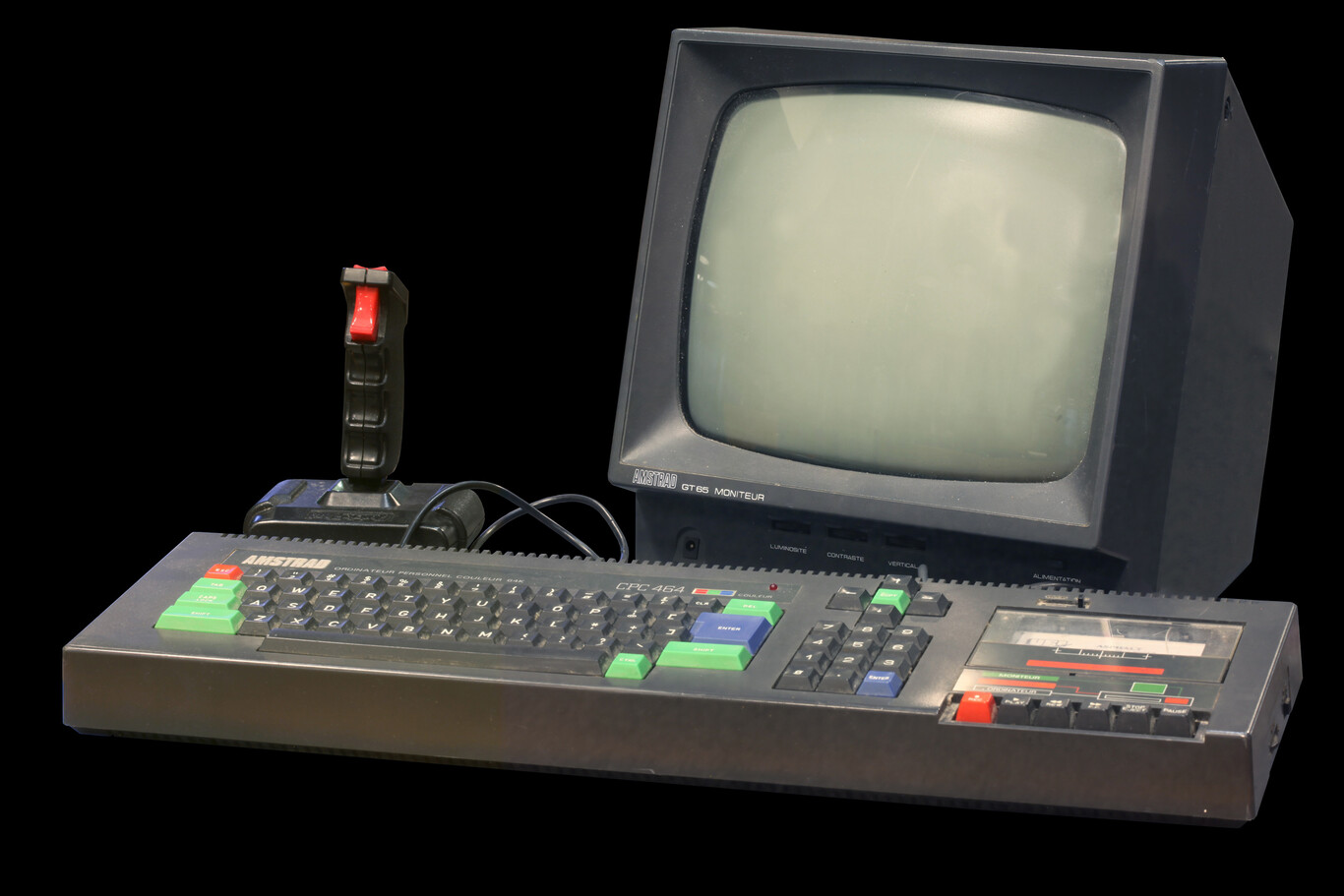
Our shop sold almost everything except what people wanted. That was how my mother described it in the spring of 1985, when I was sixteen and old enough to understand that she was only half joking.
The window displayed electric kettles, lampshades, batteries, extension leads and two radios that had faded in the sun. Behind the counter stood narrow shelves of screws, plugs and fuses, each item recorded in my father’s sloping handwriting inside a thick blue ledger. He had known where everything was. After he died, the shop became a puzzle whose solution had gone with him.
Mother opened at eight every morning and closed after seven. She learned suppliers’ names, repaired loose plugs and smiled at customers who said, “Your husband used to give me a discount.” At night she sat at the kitchen table with invoices arranged around her like fallen cards. I sometimes found her asleep there, pencil still in hand.
I helped reluctantly. I wanted to be anywhere except behind that counter, breathing dust and hearing stories about my father. I had become convinced that the shop represented the past, and that my future would begin only when I escaped it.
Then an Amstrad CPC 464 appeared in the window of the electrical warehouse across town.
Everything in one box
I stopped to look every day on my way home from school. Other computers required a television, a separate cassette recorder and a collection of mysterious leads. The Amstrad seemed complete. The keyboard contained its own cassette deck, and beside it stood a green-screen monitor designed for the machine. A card promised 64K colour personal computer, although the monitor’s world was made entirely of green.
To me it looked professional. Not like a toy squeezed beneath the family television, but like the computers I imagined inside banks and laboratories.
I brought home a brochure and placed it beside Mother’s ledger.
“We could use it for the shop,” I said.
She looked at the picture, then at the price. “We already have a calculator.”
“It could remember the stock. And print invoices.”
“Does it come with a printer?”
“Not exactly.”
“Does the program already exist?”
“Not exactly.”
She returned the brochure to me. “Then what you are proposing is an expensive way to own more work.”
Her answer should have ended the matter. Instead, I spent the next week drawing an imaginary stock system in an exercise book. Each product would have a number, a description, a quantity and a price. Sales would reduce the quantity. When stock became low, the computer would tell us what to order. I knew almost nothing about programming, but ignorance at sixteen can resemble confidence.
Mother found the exercise book beneath the counter. She read every page while I pretended to arrange batteries.
“If we bought this computer,” she said, “could you really make it do these things?”
I heard the seriousness in her voice and nearly confessed that I did not know.
“Yes,” I said.
She closed the book. “Your father would have asked for proof.”
“What do you ask for?”
“That you do not give up when it becomes difficult.”
The room changes colour
We bought the Amstrad on a Saturday. The warehouse clerk tied the two cartons with plastic cord, and we carried them back on the bus, one balanced on each of our knees. Mother paid from an envelope she had been keeping at the bottom of her handbag. Only later did I understand that it contained money saved for repairs to the shop sign.
We cleared a table in the back room where Father had once repaired radios. The Amstrad fitted together with reassuring simplicity. The monitor supplied power to the computer. The cassette deck was already built in. There were no tuning dials, borrowed recorders or negotiations with the television. I pressed the power switch, and the dark screen filled with green words.
Mother stood in the doorway. The light reflected on her face and on the shelves behind her.
“It makes this room look important,” she said.
I opened the manual at the first chapter. Soon the screen printed my name, drew lines and asked questions. Locomotive BASIC felt generous. Commands were typed as ordinary words, and error messages usually pointed towards the trouble. I began with a list of ten products. By midnight I could enter an item number and make its description appear.
On Monday, Mother showed the program to a regular customer. He watched me type 103 and saw 13 AMP FUSE glow on the monitor.
“Can it find the fuse for you?” he asked.
“Not yet,” Mother said. “That still requires a human being.”
She was smiling.
The program that would not fit
For several weeks, the project consumed every evening. I entered hundreds of products, inventing short descriptions to save memory. Mother read quantities from the ledger. I typed while she checked. The work that had seemed like a route out of the shop became the first thing that made me curious about how the shop actually worked.
Father’s ledger contained a hidden history. I could see which items sold in winter, which customers bought on credit and which stock had remained untouched for years. Mother explained the suppliers’ codes and the difference between profit and money in the till. I began to understand the worries that followed her home.
The program itself was fragile. A misplaced comma could stop it. Long descriptions pushed columns out of line. Once I forgot to save three hours of work before switching off the computer. The screen went dark, and every change disappeared.
I struck the table with my fist.
Mother did not tell me it did not matter. It mattered very much. She placed two cups of tea beside the keyboard, opened the ledger and said, “We begin again.”
Near the end of April, the worst problem arrived. The complete stock list would not fit comfortably in memory alongside the program. I tried shortening names, removing features and splitting the data into separate files. Every solution produced another difficulty. For three nights I stared at the green screen until the text blurred.
On the fourth, I told Mother we should sell the computer while it was still new.
She was sweeping the floor. “Is it difficult?”
“It is impossible.”
“Those are not the same word.”
I accused her of not understanding computers. She agreed. Then she reminded me of the promise she had requested.
“Not success,” she said. “Only that you would not give up when it became difficult.”
The first useful morning
I returned to the manual. The answer, when it came, was not clever. Instead of keeping every product in the program at once, I organised separate cassette files for different departments. It was slower, but it worked. We learned to start loading the electrical list while we opened the shutters in the morning. The cassette counter numbers were written on cards taped beside the monitor.
Our system never became elegant. It could show stock, record a sale and print a basic order list after we eventually bought a small dot-matrix printer. Its green text flickered. The tapes sometimes failed. Mother continued to keep a paper notebook “in case your important room changes its mind.”
But the system revealed that we had money trapped in products nobody bought. Mother sold the oldest stock at a discount and used the space for cables, plugs and small electronic items customers had begun requesting. I designed labels on the computer. We moved the Amstrad to the front counter, where its green monitor attracted schoolchildren and made older customers ask what it did.
One morning a local electrician handed Mother a page of handwritten requirements for a large job. She entered the item numbers, checked the quantities and produced a total while he waited. When the printer finally rattled out the invoice, she tore off the paper and examined it as if it were an official document from the future.
After the customer left, she placed the invoice beneath the glass counter.
“Your father would have kept this,” she said.
It was the first time she had spoken about him without sadness filling the whole room.
The sign we did not repair
The shop survived. It never became large or modern, but it adapted. I stayed through the summer and then studied computer science in the evenings while continuing to help Mother. The Amstrad taught me enough to obtain my first office job, where the machines had colour screens and disks that loaded in seconds. None seemed as dependable as that green monitor in the back room, even when they were.
Mother ran the shop for another twelve years. When she finally retired, we found the original Amstrad beneath the counter, wrapped in a cloth. Beside it was the exercise book containing my impossible plan and the first invoice we had printed. The paper had faded, but she had written the date on the back.
Today the computer sits in my home. When I switch it on, the green screen illuminates the room with the exact colour of those late evenings. I see my mother reading quantities from the blue ledger, patient after a long day. I see two cups of tea beside the keyboard. I see a sixteen-year-old who believed he was building a program to escape the family shop, slowly discovering that he was helping his mother remain inside it.
The old sign above the door was never repaired. For years, one letter remained darker than the others because Mother had spent the money on the Amstrad instead. I used to feel guilty whenever I looked at it.
Now I understand that she had chosen the better sign: a pool of green light in the back room, announcing that the future had not passed us by.