Personal memory · Winter 1982
The boy who stayed after school.
I thought the BBC Micro was simply another machine to supervise. Then a quiet pupil used it to show me the intelligence our classroom had failed to see.
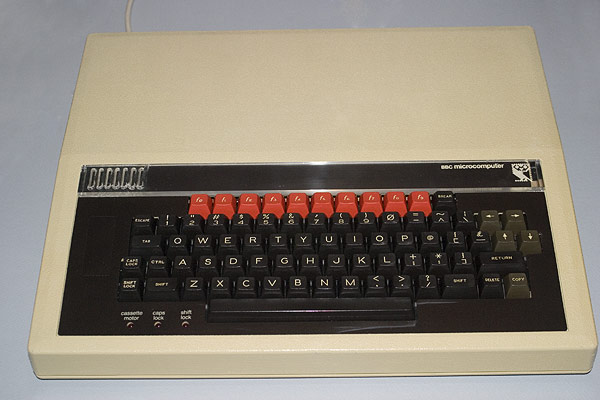
The BBC Micro arrived at our school on a wet Tuesday in November 1982. It came in three boxes and with more authority than some members of staff. The headmaster carried the monitor himself. The deputy followed with the computer, and I was entrusted with the disk drive even though none of us knew exactly what it did.
We placed everything on a trolley in the library. By morning the machine had acquired a handwritten notice: DO NOT TOUCH WITHOUT PERMISSION.
I was twenty-eight, teaching mathematics and general science, and I received the responsibility for the computer because I was the youngest teacher in the room when the headmaster asked for volunteers. This was considered sufficient qualification. I attended a Saturday course, learned enough BBC BASIC to draw triangles and make the machine beep, then returned as the school’s reluctant expert.
The pupils were less cautious. They gathered around the trolley whenever it moved through the corridor. To them the BBC Micro was not an expensive educational resource. It was a door, and they wanted to know what was behind it.
One boy never joined the crowd. His name was Michael Reed.
The last desk
Michael sat at the back of my second-year class. He was thirteen, small for his age and skilled at becoming invisible. His exercise books were untidy. Words appeared with letters reversed or missing, and numbers that he understood aloud seemed to change shape when he wrote them down. At that time we spoke less about learning differences than we do now. The usual description was careless.
I used that word on one of his reports.
Michael rarely caused trouble. He simply withdrew. If I asked a question, he looked at the desk. If another pupil laughed when he read aloud, his face closed. I tried moving him nearer the front and gave him extra copying practice. Neither helped. By Christmas I had begun to think of him as a pupil who would endure school rather than benefit from it.
Then I found him alone with the computer.
It was nearly five o’clock. Rain struck the library windows, and the corridors were empty. Michael stood beside the trolley with the manual open. The BBC Micro was switched on. A short program filled the screen.
I was angry first because anger was easier than surprise.
“Who gave you permission?”
He stepped away so quickly that he knocked a chair. “Nobody, sir.”
“Then you know you should not be using it.”
He nodded. On the screen, lines of coloured squares formed a symmetrical pattern. I recognised a FOR loop, but not how he had made the colours repeat.
“Where did you get the program?” I asked.
“I wrote it.”
I did not believe him.
Show me
Michael explained that he had watched the Saturday computer programme on television. He had copied commands from the screen onto scraps of paper, then read the manual during lunch. The words were difficult, he said, but the examples made sense because he could see what each line changed.
“Show me,” I said.
I deleted the program. It was a cruel test, and I regretted it as soon as the screen cleared. Michael stared at the empty prompt. Then he sat down and began again.
He typed slowly with two fingers. The keys were large, their red function-key strip bright against the brown case. He made mistakes, but corrected them without embarrassment. When he reached a command he could not spell, he looked at the manual rather than guessing.
After twenty minutes, he typed RUN.
The screen filled with the same tiled pattern.
I pulled up a chair. “Why does it mirror in the middle?”
For the next ten minutes Michael spoke more than he had spoken in my classroom all term. He described coordinates, loops and the remainder after division. He did not use every technical term correctly, but his reasoning was exact. The boy whose written work I had marked careless had built a mathematical design from instructions he had gathered alone.
At six, the caretaker appeared and asked whether we intended to spend the night.
Before Michael left, I gave him a key to the library.
“Only after school,” I said. “And only when I am here.”
He held the key as if it were a medal.
The planet on the screen
Our after-school sessions became a routine. Michael arrived at half past three, waited while I finished marking and then wheeled the computer towards the nearest socket. I taught him what I knew, which took less than a week. After that we learned together.
He preferred problems with a visible result. He drew spirals, generated mazes and made blocky figures walk across the screen. The BBC Micro responded instantly. It did not sigh at his spelling, compare him with other pupils or become impatient when he needed to read something twice. If the program failed, the error belonged to a line, not to the person who had written it.
For the school science exhibition, pupils were asked to make projects about the solar system. Most produced painted models suspended from coat hangers. Michael proposed a program that would display the planets and their distances from the Sun.
It was too ambitious. We had limited memory, one unreliable disk and a printer that jammed whenever anyone important entered the room. But I remembered the report I had written and told him to try.
For six weeks we worked in the library. Michael calculated a scale that would fit the inner planets on screen, then invented a separate view for the outer planets. He used circles made from plotted points. He added keys to move between screens and short descriptions drawn from encyclopaedias. I helped organise the program, but its best feature was entirely his.
When a planet appeared, a small marker travelled across the screen at a speed related to that planet’s orbit. The motion made the differences understandable in a way our textbook never had.
The night before the exhibition, the disk refused to load.
Michael’s face went white. Months of work seemed to have vanished into the drive. I tried every procedure from the manual and several invented through desperation. Nothing worked.
“I have most of it at home,” he said quietly.
He opened his school bag and removed a bundle of paper. He had printed each section of code after every session and kept the pages in order. The pupil I had called careless had made the only proper backup.
We retyped the program until nearly ten. His mother brought sandwiches. The caretaker stopped pretending to be annoyed and made tea. Shortly before we finished, the coloured image of Saturn returned to the monitor. Its small marker began its patient journey across the screen.
Three adults cheered. Michael only smiled.
The question I had asked wrongly
At the exhibition, visitors queued to use Michael’s program. Younger children pressed the red function keys while he explained the planets. Parents asked him questions. The headmaster brought two governors and introduced Michael as “our computer specialist.” Each time he heard it, he stood a little straighter.
His father arrived near the end, still wearing his work clothes. He watched from behind the crowd until Michael noticed him. I saw their eyes meet across the library. Michael did not wave; he simply began his explanation again, more carefully than before.
When the last visitor left, his father shook my hand.
“We did not know he could do this,” he said.
I wanted to answer that I had taught him. The truth was the opposite. Michael had shown me how little our usual measures revealed. I had been asking why he could not work like the others, when I should have asked what allowed him to show his mind.
I rewrote his report that evening. I removed the word careless.
The key returned
Michael stayed after school for the next four years. Other pupils joined him, and our informal sessions became a computer club. The BBC Micro collected scratches and sticky keys. Its disk drive was replaced, its monitor lost some brightness, and the warning notice gradually curled at the corners. Yet the machine remained the most sought-after object in the school.
On Michael’s final afternoon, he placed the library key on my desk. He had earned a place on an electronics course. Neither of us was comfortable with goodbyes.
“You will need this for the next one,” he said.
Inside the computer’s welcome disk he left a small program. When it ran, coloured tiles spread from the corners and met in the centre, recreating the design I had seen on that first rainy evening. Then a message appeared:
THANK YOU FOR LETTING ME STAY.
Nearly forty years later, I attended a school reunion. Michael came carrying a small circuit board he had helped design. He had spent his career building control systems, work requiring the same patient logic I had once failed to recognise. He told me the BBC Micro had changed his life.
I told him it had changed mine too.
The computer did not make Michael intelligent. It did not rescue him or place something inside him that had not existed before. It simply offered a language in which his intelligence could become visible. For a teacher, that was the more important miracle.
I still have the old library key. Its label has faded, and the door it opened was replaced long ago. Whenever I hold it, I remember a thirteen-year-old boy at the last desk, a bright pattern growing across a screen, and the evening I finally learned to ask a better question.