Personal memory · Autumn 1984
The song hidden inside the Commodore 64.
My older brother was leaving home, and the music we made on a beige computer became our way of saying what neither of us could say aloud.
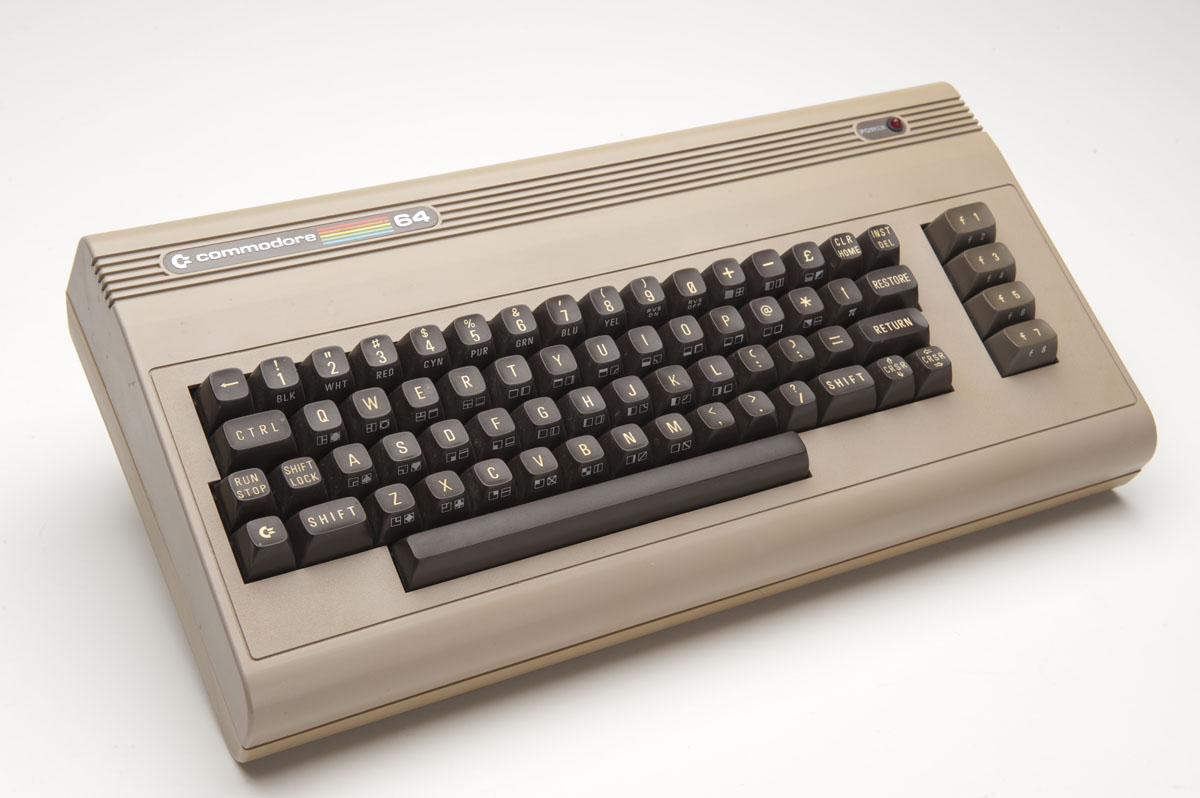
In the autumn of 1984, my brother Daniel was seventeen and already halfway out of our house. He had passed the entrance examinations for a technical college in another city, and everything he did seemed to point towards leaving. Cardboard boxes stood against his bedroom wall. University prospectuses lay open on the kitchen table. He spoke about railway times, shared rooms and people none of us knew.
I was fourteen and furious with him for going.
I did not admit that, of course. I made jokes about finally getting the larger bedroom. I told him I would throw away his football magazines and use his shelves for my books. When our mother asked whether I would miss him, I said, “Not particularly,” with the cold confidence only a younger sister can manufacture.
Daniel answered in the same language. He said he would enjoy the peace. Yet each evening he came into the living room and sat beside me, usually without explanation. Sometimes we watched television. Sometimes he corrected my mathematics homework. We never discussed the date circled on the calendar.
Then, three weeks before he was due to leave, our father carried home a large brown carton with Commodore 64 printed across it.
A machine for practical purposes
Father worked in accounts and distrusted anything sold as entertainment. The computer, he explained, was not a toy. It would help Daniel with his studies. I could use it for schoolwork, provided I treated it properly. He had bought it second-hand from a colleague, together with a cassette recorder, two joysticks and a shoebox of tapes.
“Sixty-four kilobytes,” Daniel said, lifting the machine from its packaging.
“Is that a lot?” Mother asked.
“Enormous,” he said with complete sincerity.
The Commodore was broad and heavy compared with the slim computers in magazine advertisements. Its dark brown keys rose above a beige case that looked almost serious enough to satisfy Father. Daniel connected it to the television, and a blue screen appeared with pale blue letters. At the top it announced 64K RAM SYSTEM. Beneath that was the word READY. and a blinking square.
I liked that word immediately. It seemed less like a status message than an invitation.
For the first week the machine belonged mostly to Daniel. He learned how to load games and how to save small BASIC programs onto cassette. We played International Soccer until our thumbs hurt. We guided a tiny figure through impossible rooms, argued over whose turn had ended, and discovered that Daniel was a gracious winner but an unbearable loser.
For those evenings, his boxes disappeared. We were children again, sitting too close to the television while Mother told us to lower the volume.
The sound that was not a beep
One Saturday, Daniel returned from the newsagent with a computer magazine folded beneath his coat. It contained a program that could play a simple tune through the Commodore’s sound chip. The listing covered nearly two pages: rows of numbers, POKE commands and DATA statements that meant nothing to me.
“This machine has a proper synthesiser inside it,” he said. “Three voices. Not just beeps.”
Daniel loved music. He owned a battered acoustic guitar and knew the opening chords of dozens of songs, though rarely the complete song. I expected him to type the program himself, but he put the magazine between us and pointed to the first line.
“You read. I’ll type.”
We worked all afternoon. I called out line numbers and clusters of digits while his fingers moved across the keyboard. Every few lines he stopped and asked me to check what I had read. I resented the questions until the program refused to run. The screen displayed ?SYNTAX ERROR IN 180, and we began the slow search for our mistake.
It was mine: 54273 instead of 54276.
“Three numbers,” I groaned. “All this because of three numbers.”
Daniel did not laugh. “Music is made from small differences,” he said, correcting the line.
He typed RUN. For a second nothing happened. Then the television produced a clear electronic note, followed by another and another. The melody was simple and slightly mechanical, but it possessed a richness I had not expected. It sounded as if a tiny instrument had been waiting inside the beige case for us to find it.
Daniel played the program again. This time he picked up his guitar and tried to accompany it. The guitar was out of tune, the computer was too loud, and we lost our place halfway through. I laughed until I could hardly read the screen. Daniel restarted the program, and we tried again.
That was the beginning of our song.
Three voices
During the next two weeks we changed the program. Daniel found a table that translated musical notes into the numbers required by the SID chip. I drew graph-paper bars for the melody. He added a bass line; I insisted on a third voice that rose above the others at the end. We understood perhaps half of what we were doing, but each experiment taught us something.
A wrong number could turn a warm note into a metallic shriek. A short pause could make the next phrase seem brighter. When the program crashed, the Commodore sometimes held a continuous tone until we reached for the power switch. Mother would call from the kitchen, “Is that supposed to be music?”
“Nearly,” we always replied.
The tune itself came from a melody Daniel had hummed for years while doing homework. It had no words and no name. On the computer it became more deliberate. The first voice was steady and low. The second answered it. The third entered late, uncertain at first, then joined the others for the final passage.
One evening I realised what Daniel was doing. He had arranged the parts so the high voice—my voice, I thought—continued after the lower melody faded.
“Why does that one finish alone?” I asked.
He looked at the listing instead of at me. “Because one part can carry the tune when another stops.”
I wanted to tell him I did not want it to stop. Instead I said the ending was too quiet.
He changed it.
The last cassette
On the night before Daniel left, the house filled with relatives bringing advice and food. Everyone spoke about his future. An aunt gave him towels. Father checked his train ticket three times. Mother moved between the kitchen and his suitcase, adding things whenever he was not looking.
Near midnight, after the visitors had gone, Daniel and I loaded our music program. We had saved it on a blank cassette with a handwritten label: THREE VOICES—FINAL. The program took several minutes to load, and we listened to the familiar chatter of electronic noise without speaking.
When the blue screen returned, Daniel dimmed the room lights and typed RUN.
The melody began. Through the television’s small speaker, the notes sounded fuller than they had during our experiments. The bass voice established the path. The second voice wandered around it. Then my high part entered, and for a few bars all three moved together. At the ending, Daniel’s lower line fell silent. Mine continued for four more notes before resolving on the note we had chosen together.
Neither of us moved.
“It needs a title,” I said at last.
Daniel took the pen from beside the cassette and crossed out THREE VOICES. In its place he wrote HOME.
“That is not very original,” I said, because my throat had tightened.
“It does not have to be original. It has to be true.”
He gave me the cassette. I told him it was our only copy, but he had made another without telling me. He placed it in the front pocket of his suitcase, between a packet of guitar strings and the railway timetable.
Ready
For months after Daniel left, the Commodore 64 sat on the desk in his old room. The larger bedroom became mine, as promised, but I kept his posters on the wall. On Sunday evenings he telephoned from a payphone in the college corridor. The calls were expensive, so we spoke quickly. He asked about home, school and, always, the computer.
I began writing my own programs. At first they were small: a quiz, a scrolling message, coloured patterns that changed with a key press. Then I returned to our music listing and learned what its mysterious numbers actually controlled. I altered waveforms, envelopes and timing. I filled a notebook with experiments. The Commodore had become more than the thing Daniel and I shared; it had shown me that technical instructions could contain feeling, and that logic did not have to be cold.
At Christmas he came home carrying his cassette copy in his coat pocket. We loaded it before he unpacked. One note sounded wrong because the tape had been damaged, and we spent an hour repairing the data from my copy. Father watched us from the doorway with the pleased expression of a man whose “practical” purchase had justified itself in ways he could not have predicted.
Years later, Daniel became an engineer. I studied electronic music and eventually worked in sound design. We travelled, married, raised families and filled our lives with machines thousands of times more powerful than the Commodore. Yet whenever we meet, he still hums the first bars of Home, and I answer with the higher phrase.
The old computer remains in my study. Its plastic has darkened, and several keys shine from use. In the drawer beneath it lies a cassette with Daniel’s handwriting on the label. The tape may no longer load; I have never tested it. I do not need to. I can still hear every imperfect note.
People remember the Commodore 64 for its games, its colours and the extraordinary sound chip inside it. I remember something simpler. At fourteen, I thought my brother’s departure would leave only silence. Instead, a beige computer taught us to place what we could not say into three electronic voices—and to trust that one voice could travel away while the other still carried the song at home.
READY.