Personal memory · Piraeus, 1983
The computer that crossed the sea.
My father returned from a long voyage carrying a NewBrain no one else had heard of, and together we learned how a strange machine could shorten the distance between departures.
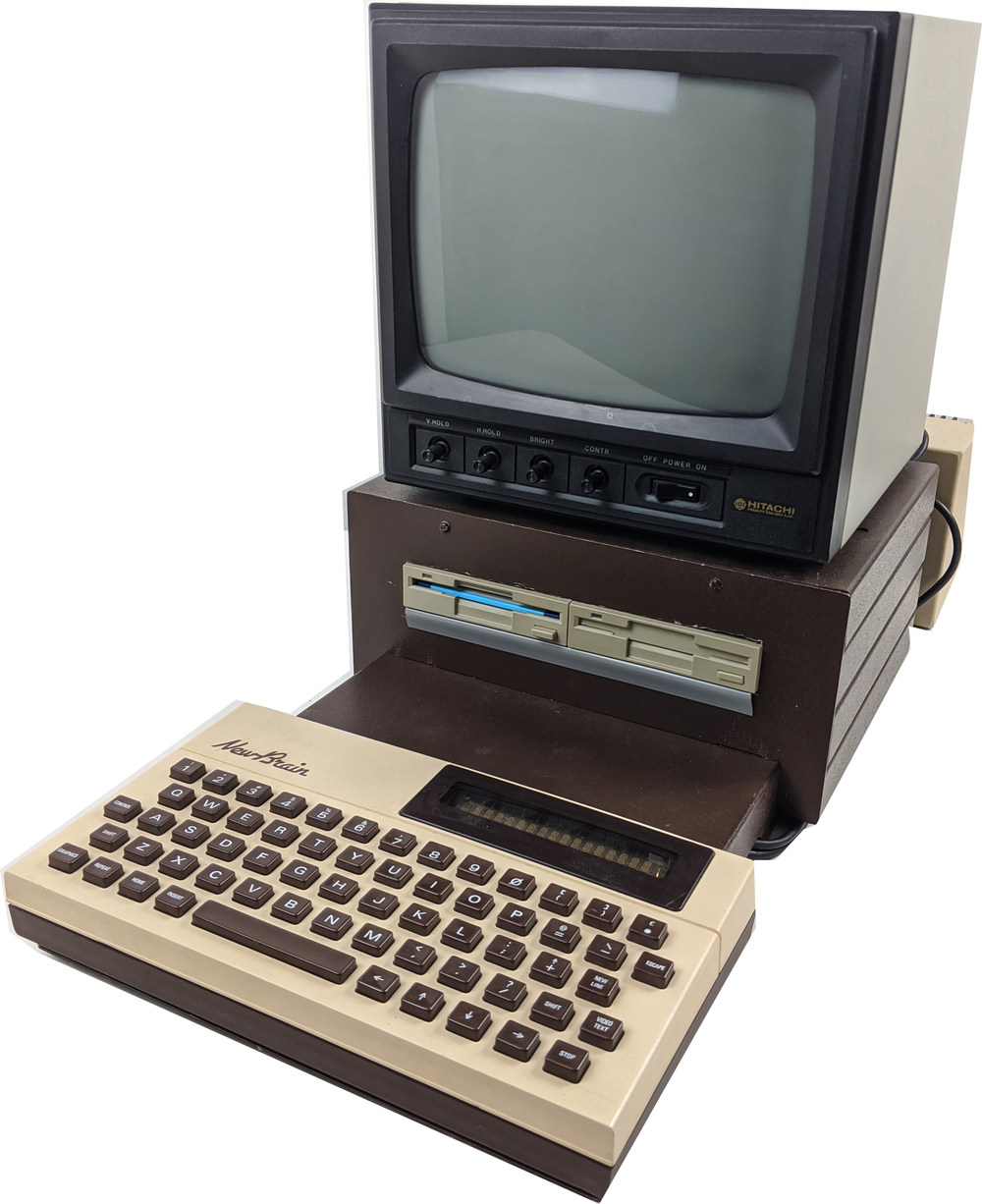
My father came home from the sea in March 1983 carrying two suitcases, a canvas holdall and a cardboard box protected with more care than any of them.
We watched from the balcony as the taxi stopped below our apartment in Piraeus. My mother ran downstairs before the engine had stopped. I followed more slowly, because I was fifteen and had reached the age when love for a parent was something to disguise.
He had been away for seven months. At first his absence had been measured in letters and marks on the calendar. Then it had become ordinary: his chair remained empty, Mother handled every problem, and his voice arrived through expensive telephone calls full of delay. By the time he returned, I had grown taller than she was. I wondered whether he would notice.
He embraced me in the street and held me at arm’s length.
“You have changed,” he said.
So had he. There was more grey in his hair and a tiredness around his eyes. We carried the luggage upstairs. He refused to let anyone take the cardboard box.
Inside was a computer called a NewBrain.
The machine nobody knew
I had read about home computers for more than a year. My friends argued about the ZX Spectrum and Commodore 64. Computer shops displayed familiar names in their windows. None of us had seen a NewBrain.
Father had found it in Southampton during a short stay in port. A radio officer told him it was powerful, portable and equipped with an excellent version of BASIC. The name appealed to him.
“A new brain is useful at any age,” he said.
The computer was narrow and businesslike, with dark keys and a small display built into the front of our AD model. It looked less colourful than the machines in magazines. There was no rainbow stripe, no friendly badge and almost no software in the box. Father had also bought a cassette recorder, cables, a thick manual and one demonstration tape.
“What games does it have?” I asked.
He searched the packaging. “The man did not mention games.”
Disappointment entered the room before I could stop it. My best friend owned a Spectrum and traded cassettes every week. What use was a rare computer with no games and no one nearby to exchange programs with?
Father read my face. After seven months away, his first gift had failed.
“Perhaps we should learn what it can do,” he said.
I shrugged. “Perhaps.”
Latitude and longitude
For several days the NewBrain remained on the dining table. Father slept at unusual hours, visited relatives and repaired small household problems that had accumulated during his absence. We spoke politely but without ease. He remembered the child I had been when he sailed; I had practised becoming someone else.
One evening he opened the manual. The NewBrain’s tiny fluorescent display illuminated his hands with pale green characters. He typed a few lines, frowned and called me over.
“It says error.”
“What did you type?”
“Something wrong, apparently.”
I found a missing bracket. The program calculated distance from speed and time, a problem simple enough for paper. Yet when it ran, Father entered numbers from an old notebook. He showed me dates, noon positions and distances travelled during his voyage.
“Every day at sea has a number,” he explained. “Latitude, longitude, course, speed. Numbers tell you where you are.”
“But you already know how to calculate all that.”
“Yes. Now we teach this.”
We began building a voyage program. He explained nautical miles and great-circle routes. I translated what I understood into BASIC. The NewBrain’s interpreter accepted long variable names, which made our code readable: DISTANCE, SPEED, DAYS. When the small display became too cramped, we connected the computer to the television and filled the screen with tables.
The work changed our conversations. Instead of asking how school was and receiving “fine,” Father asked why a loop stopped at twenty-four. I asked what happened when a ship crossed the date line. He told me about storms in the North Atlantic, stars seen far from city lights and the loneliness of standing watch while everyone at home slept.
For the first time, his voyages became more than absence. They became places I could imagine.
The departure program
Father’s leave lasted ten weeks. As the days passed, his belongings slowly gathered near the bedroom door again. I pretended not to notice. The voyage program grew more ambitious.
We added fuel consumption, estimated arrival time and a simple representation of the ship moving across a line. Father supplied realistic figures. I designed menus. When the cassette recorder failed to save reliably, he cleaned and adjusted it with the same patience he used on navigation instruments.
Then he suggested a new feature: a countdown to his return.
His next contract was expected to last six months. The computer would begin with the departure date, calculate the days remaining and show a small ship progressing towards home.
“The date can change,” Mother warned from the kitchen.
She knew the uncertainty of shipping schedules better than either of us.
“Then the program can change too,” Father said.
I did not want a countdown. Marking days on the calendar had made his previous absence feel longer. I said the idea was childish.
Father looked at the screen. “It is not only for you.”
That sentence revealed something I had not considered: departure was also happening to him.
We called the program HOMEWARD. Each time it ran, the NewBrain asked for the current date. It displayed the estimated days remaining and printed a short message chosen from a list. Some were practical—KEEP WORKING or ONE DAY CLOSER. One was my mother’s: THE LIGHT IS ON.
My contribution appeared only when the remaining days reached zero:
WELCOME HOME, CAPTAIN.
Father was not the captain, but he allowed the promotion.
Messages across the water
On the morning he left, Father packed a duplicate cassette of our programs in his case. The ship did not have a NewBrain, but he said he wanted the tape with him. I stood with Mother at the passenger terminal, watching him move through the barrier. This time I did not hide behind a careless wave. I embraced him and felt the cassette case in his coat pocket.
At home, the computer occupied his empty place at the table. Every Sunday I ran HOMEWARD and entered the date. The little ship advanced. The messages changed.
Father wrote from ports along the route. His letters contained improvements for the voyage program, sometimes written on the backs of cargo documents. In return I mailed printed listings and descriptions of what the computer displayed. We had discovered a form of correspondence made from code.
At school, my friends remained unimpressed by the NewBrain. Their computers had hundreds of games. Mine had programs about distance, fuel and dates. I minded less than before. Rarity had first felt like isolation; now it felt like a private language between Father and me.
Midway through the voyage, his ship was delayed. Mother received a call saying the return might be five weeks later. That evening I entered the new date into the program. The ship on the screen jumped backwards.
I stared at it with unreasonable anger. The computer had only obeyed me, yet it seemed to have broken a promise. I nearly switched it off. Then the message appeared:
THE LIGHT IS ON.
I called Mother to the room. We sat beside each other in the green glow of the small display until neither of us felt the need to speak.
The harbour at dawn
Father returned in November, before the revised date but after the original one. His ship entered the harbour at dawn. We were waiting near the terminal as the sky turned silver above the cranes.
At home, before unpacking, he asked about the NewBrain.
I loaded HOMEWARD. The cassette took two attempts. When the program requested the date, Father typed it himself. The little ship crossed the final position, and the message filled the television:
WELCOME HOME, CAPTAIN.
He laughed, but his eyes shone. Then he placed his hand on my shoulder and said, “You kept our position.”
During later voyages, the NewBrain remained our shared instrument. I wrote programs for school and eventually games of my own. Father continued sending problems from the sea. By the time I entered university, the machine was outdated and difficult to repair, but it had already done its important work.
It had given us a way to know each other between the departures.
My father is gone now. The NewBrain rests in its case, beside the manual marked with his calculations. Inside are two cassettes. One is labelled VOYAGE. The other, in his handwriting, simply says HOME.
Modern ships cross oceans guided by satellites and computers of astonishing precision. Families speak through video calls from almost anywhere at sea. I am grateful for all of it. Yet part of me still believes distance is measured by a blinking ship on a television screen, moving one character at a time towards Piraeus.
Whenever I switch on the NewBrain, its little green display wakes before the larger screen. For a moment, it resembles a light seen from far offshore. Then the prompt appears, patient and familiar, and I hear my father’s voice explaining that every day at sea has a number.
Numbers told us where he was. The computer taught us where home was.